
This post contains affiliate links.
If you’re anything like me, you easily tire of having the same nail polish color on for too long. But for one reason or another, you can’t keep changing your nail polish every time you get bored with its color, because it gets pretty expensive. So today I will give you a guide to color-changing nail polish that can add some excitement to your pedicure.
Color-changing nail polish comes in various forms such as solar reactive, thermal, and holographic. The properties inside these polishes react to an external element, such as light, heat, and refraction to produce color changes in various ways. There are even ways that you can make your own color-changing nail polish.
I will first describe the different types of color-changing nail polishes and explain how each works. Next, I will give you useful tips to remember when purchasing these nail polishes as well as an easy guide to make them yourself if you don’t want to buy them. Lastly, I will show you how to use these nail polishes.
Table of Contents
Types Of Color-Changing Nail Polish
1. Solar (“Sun”) Reactive
A similar type of color-changing nail polish that is quite like thermal is solar reactive polish. “Solar” refers to the sun. Therefore, solar reactive polish changes from one color to another when exposed to sunlight or any other kind of ultraviolet (UV) light.
When inside your home, under your normal light, your nails could be green and when you go outside for some vitamin D, your nails could change into red. Color-Changing Nail Polish works by exposure to ultraviolet (UV) radiation. The UV Radiation creates a chemical reaction with the pigments in the polish which results in a different look to the human eye.
UV radiation comes in multiple forms that cause various reactions depending on the pigments in each polish.
2. Glow In The Dark
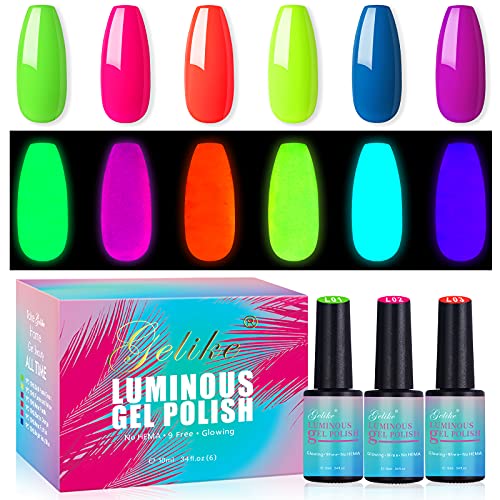
Opposite to solar reactive polish, glow in the dark polish is used in the dark. Glow in the dark polish has uncolored pigments in it so nails look normal to slightly white under regular light. When you turn off the light your nails will start to glow with this polish on.
Is that ectoplasm on your nails or glow-in-the-dark polish?
Glow in the Dark nail polish is based on the chemicals more, which hold in the light like a solar panel and react/change color when in the dark. In your glow-in-the-dark nail polish, there is a phosphorene substance that will cause the nail polish to glow. Phosphorescent materials absorb light and increase the energy levels of the electrons in the material causing them to release light as the energy levels start to decrease.
If you have ever tried glow-in-the-dark nail polish before you will know that it will eventually return to its normal state. This is because once the energy levels return to a normal state light is no longer emitted. You will find to keep your nails glowing you will have to
- “Charge” them up by placing your hands back in the sun so that they can absorb the light or;
- Use black light which will allow them to glow without dimming.
You can make your own glow-in-the-dark nail polish. Here are the items you’ll need.
- Glow in the dark pigment powder
- Clear nail polish
- Paper or Funnel
- Two or three ball bearings
Glow In The Dark Pigment Powder
You can purchase these online. However, ensure to get a powder that doesn’t have any toxins and that is safe for you to use on your skin.
If you have a full bottle of clear nail polish you will need to throw a small amount out to make room for the other ingredient. Next, you will place your ball bearings inside the clear nail polish. If you have a paper you can form it into a funnel or just use a regular funnel to transfer about one teaspoon of the powder into the nail polish.
Use more powder the more opaque you would like your nails to become.
Next, tightly close the bottle and give your polish some gentle shakes, ensuring not to shake vigorously as this will cause air bubbles.
Your paint is ready to go. You can either use this mixture as your regular nail polish or you can apply nail polish first and use this polish as a topcoat.
3. Holographic
Another fun type of nail polish is Holographic polish. Holographic polish is similar to regular nail polish but has a pigment that refracts the light very well making it look like a rainbow. Holographic nail polish does not reflect light as the other polishes do, it refracts it like a prism.
This polish takes the normal white light and breaks it down into little crystal-like forms that look like rainbows.
To take you back into a little science lesson, white light actually consists of many colors. The nail polish has a pigment like Spectraflair. This pigment is considered a holographic particle.
This holographic particle in your nail polish will split the white and cause the different colors to become visible.
You can use pre-made holographic nail polishes which are applied in the same manner in which you would apply regular nail polish.
However, if you want to use holographic powders instead, it is best to have a nail tech apply it for you as it needs a very precise application to get the sharp bright refraction that you’re looking for. If you’re still interested in giving it a try for yourself I will guide you on how to do it.
After prepping your nails (a detail which I’ve described below when explaining how to apply thermal nail polishes), apply a base coat then add a layer of regular nail polish. Your nail polish needs to be white or plain for it to work. If you’re a beginner, try sticking to white at first.
Next, you will need to apply a gel topcoat. This will provide a proper surface for the powder to adhere to.
Here is where you need to be very careful. You will have to dab a small paintbrush or makeup brush in your holographic powder and then dab (not pull) the powder onto your nail from base to tip. Wait for it to dry then use a clean dry brush to brush away the extra powder.
You will then apply another layer of the gel topcoat over your powdered nails. Afterward, cure in UV light for up to two minutes. And there you will have your holographic nail polish.

4. Multi-Chrome (Duo-Chrome or Chameleon)
Rather than seeing all colors of the rainbow-like with Holographic polish, Multi-chrome polish is only a couple of colors. This nail lacquer changes based on the angle you view it from. Let’s say my polish looks pink from one angle but I move my hand and it looks red from a different angle.
Want to look different from every angle? Then this nail polish is right for you
Multi-Chrome nail polish relies on the pigments’ layers. These pigments are reflective and settle into separate layers on each nail. These layers consist of lower layers that make the nail look one color from an angle and higher layers that reflect a completely different color from another angle.
5. Thermal/Thermochromic Nail Polish
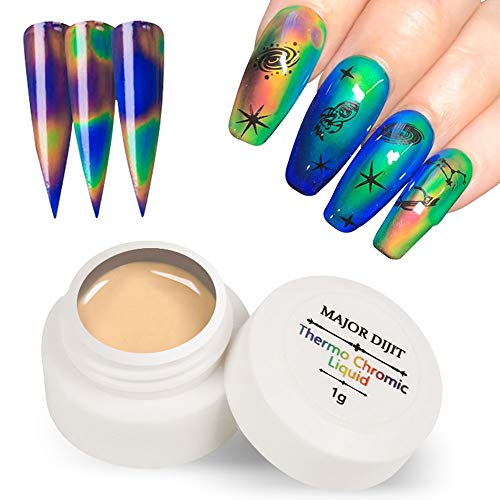
There are various fun color-changing nail polishes. One of the most popular polish types is Thermal or Thermochromic nail polish. “Thermo” means temperature and “chromic” means color. This type of nail polish changes color in response to the change in temperature.
On a warm, sunny summer day, your nails could look pink. On a cold, snowy winter day, your nails could look teal.
Thermal nail polish works by using ultraviolet radiation from fluctuating temperatures. It changes color because of an ingredient called leuco dye. Leuco dye has two forms, colorless and colored.
Leuco dye can transition between these two states in response to heat. The solvent in the nail polish is what causes the leuco dye to change color. When the solvent in the nail polish is cold it will solidify which stops it from reacting with the dye.
This means the dye will remain the color that it was placed in, However, when the solvent gets warm from surrounding temperatures, the solvent liquifies and binds with the dye causing it to change color.
DIY Thermal Nail Polish
You can create your very own Thermal Nail Polish at home, saving you the trouble to purchase some. And it works just as fine!
You will need the following items:
- Funnel
- Empty Nail Polish Bottle
- Glass ball bearings – so you can mix the polish
- Leuco dye
- Topcoat is a white, pale, or clear color
First, place one or two ball bearings inside the empty nail polish bottle. Next, take your funnel and place it inside the bottle. Pour the top coat of your choice into the funnel until it reaches halfway.
Next, add leuco dye until you have achieved your color change. This normally takes a little under a teaspoon of dye to get done. If you don’t see the color change you might be working in too warm an area.
You can place your bottle in the fridge to see the color it will change to.
Seal the bottle with the polish cover and gently shake, allowing the ball bearings to mix the formula on the inside. Ensure to not shake vigorously as you may get air bubbles into the mixture and ruin the nail polish.
If the mixture ends up becoming too thick you can always put two or three drops of nail polish thinner (preferably using an eyedropper) into the mixture and gently roll it between the palms of your hands. Depending on the color you used to make your DIY thermal nail polish, the color you will see when the temperature is warm is white, clear or whichever pale color you used as the base.
The color that your polish turns into once it’s cold will depend on the color leuco dye that you use. There are at least fifteen colors to choose from. It will take a basic understanding of color mixtures to understand what color you can expect from your leuco dye once it is mixed with the nail polish.
I’ll give you three examples below:
If I would like my nail polish to change from baby blue to green then my formula will be:
Baby blue nail polish + Yellow tinted leuco dye = green nail polish.
Likewise, two more of your options could be:
Pink nail polish + blue leuco dye = purple nail polish
Pink nail polish + yellow leuco dye = a light orange nail polish.
When purchasing your dye, choose the powder form to have a better quality mixture.
Mood Changing Nail Polish
The most common type of Thermal nail polish is mood-changing polish. This means your nail polish is supposed to change colors based on your mood. In relation to how thermal nail polishes change color due to the temperature fluctuating; your body temperature changes when your mood does as well.
This one is my personal favorite considering my mood and preferences are quite sensitive to what is happening around me. Whether it’s my outfit, what I want to eat, or the color of my nail polish, my mind is always changing concerning what I want.
Sometimes this can be frustrating when deciding what color polish want to use next. But with mood-changing nail polish, it changes as I change my mind (Perfect!) No more making that challenging commitment of not being able to change your nail color for a week or more!
Even though the science behind this polish shows it is purely just from changes in temperature, it still gives me that nostalgic feeling and fulfillment that mood rings gave me as a child.